
Note: George Ure wrote a book about his concept of psychocartography, but my definition of the term is not related to or based on his writings or his definition.
Releasing
I enter the labyrinth and release my past. Re- lease.
Re-inhabit. Re-member.
I pick up a thread—to find my way back.
I am my own Ariadne. Tied.
Release. Re-call.
I call to myself—
I can’t hear the answer.
I’ve spent much of my life searching for a space that felt like home simply because I never felt at home in my own skin. When I was young, my skin felt taut—like I was too big inside to fit within the frame of my bones. A frame intended for someone who cared more about the outline of her lips and the sway of her hair and less about the noise of the crickets in the woods or the pile of stones by the stream. I was trying to wedge myself into a space that I never wanted to take up. So, I lost my inherent curiosity to adopt, instead, the concerns of the male gaze. It’s a concern that never really leaves once it asserts itself; one that maps its way into nearly every cell of one’s body. Sloughing it off is like shedding the only skin you have, to realize you’re better off raw anyway. You’re better off exposed and bleeding than priming yourself for anyone else, regardless of gender.
I’ve never felt like any physical place was home until I left it. I left New Hampshire because it was stifling, and I couldn’t imagine doing the same things over and over again in the same places for the rest of my life. I made my way down the coast of California imagining I would become a person I’d only ever seen on television shows. And I came to Phoenix thinking I would have children, but I didn’t. The cartography of my life was never really about finding home, though, it was about leaving home. It was about finding an identity outside the confines of New England which felt like it was pressing its weight against my chest; obscuring my vision of what could be; what was out there.
I have imaginary maps of every important location in my life. That’s not to say that they are fiction, but rather that they reside in my imagination and in the projection of my mind. These paths never thread together to create an accurate representation of a physical space, but they connect me to a place through feeling—a road back through memory. With each visit, the topography may alter, skew—or it keeps its shape for decades, regardless of new routes and shifting landscape. It’s a way I connect with experience; a way for me to make sense of my place in the world.
Each of us experiences the world through our own lens. Our geography is our own—the routes we trace out with our feet, bicycles, cars, roller-skates—they wind a path through our psyche and shape how we relate to our surroundings as unique as a fingerprint; swirls that double back on each other and lead us through the labyrinth of our lives.
Most of my childhood memories are charted out in summers. The winters lapsed into a white-out, a fugue. After Christmas, days only counted toward orienting ourselves to the warmer months. Four more weeks before we can see the grass again. Six more weeks before we can peel off our sweaters and feel our goosebumps prickle in the 50-degree sunlight. The groundhog was only ever a shadow.
The geography of those summers can be mapped out in the thin, wobbling tracks of a ten-speed bike. Down the hill from our condominium complex, up the street that winds through a thick stand of trees, not quite woods, but dark and whispering; through a looping paved footpath, and back around, until I reached a destination or circled the entire loop again, pretending I was in a car on my commute to work. Pretending I was an adult.
This map is braided through my memory as a symbol of joy, freedom—the breeze lifting my hair around my ears and trailing behind me. This hometown path is also seamlessly linked with the streets that crisscrossed the beach town where we spent our summer vacations in Maine. We’d engage in the same activities every year, never trying anything new or exploring beyond the scope of our house and the three or four excursions our parents would take. Aside from our bike rides, beach days, and walks, we’d go to the Clam Bake, ride the bumper cars, or compete in a round of miniature golf, keeping score only to forget the entire venture within hours, to do it all over again the next day until we piled in the car and drove back to our humid hometown ninety minutes away, to wind the bike paths again, slip and slide in the communal front yard. Water and bike pedals: these destinations sectioned out our compass rose.
As an adult, my calming visual for my daily meditations is the humid, buzzing summer lawn at my grandmother’s house in Billerica, Massachusetts. I can see the plastic pool filled with frigid hose water next to the metal shed and my grandfather’s neat rows of summer squash and zucchini. It’s late afternoon and everyone’s gone inside for the heat of the day, and the only noise is the cicadas humming from wherever cicadas perch. I take a deep breath and recall how I would sit outside until I became unbearably hot, then step back inside through the Dutch doors to feel the cool burst of the air conditioner. The hum and whir of the unit propped up and jutting out of an open window would lull me into an afternoon nap on the brown velveteen couch, book splayed on my chest, my nana humming the tune to ‘You are My Sunshine’ from the kitchen.
It’s these scenes that I return to, over and over, to center myself, to find peace. It’s the map of my mind.
When I moved to California, it was to remove myself from this map, these well-trodden paths. I was tired of them and slipping into an anxiety-laced melancholy. The winters seemed longer and longer each year. Before I knew the term for it, I would sink into a deep seasonal depression, only to emerge feeling emotionally bruised and exhausted. The summer doesn’t hold the same promise at nineteen as it did at ten. I felt stuck, like I was running in place. I had always been an anxious child, but after my first year at the University of New Hampshire, I found hypochondria to be a suitable coping mechanism to deal with my parents’ divorce. They separated when I was sixteen and my map fractured. I wasn’t ready to leave home because I didn’t really have one. I was carting my life around, back and forth between my parents. When I moved to college, I was afraid, unready for a new landscape. Not capable of charting new routes. I imagined, unconsciously, that if I could keep my body safe, nothing bad would ever happen to me again. The threads of obsessive-compulsive disorder were constructing a web of perceived safety. Maybe if I left the physical space where my anxiety was born, I could shuck it off like an old skin.
As anyone could guess, it didn’t work. My OCD grew and matured into a form of health anxiety that would sometimes take over my life. So, I moved again—from San Diego to Chico, CA where I graduated from college to Santa Barbara and Los Angeles—chasing home, running from the “what ifs” that haunted me. New roads, new paths, new maps. Obviously, it was my internal map—the trail I’d been cementing in my psyche that needed repaving, re-treading.
Receiving
In the center, I take back. I receive.
Re-engage. Re-flect.
Flecks spot my vision—
Re-sieve. I sift myself through small slats in a screen.
I re-organize. My cells re-form. Reform.
I sit—palms up. Thread between my fingers.
Most internal landscapes of my past are fed through a lens of nostalgia, which is always a bit of a trick. A sepia hued recollection, never quite accurate but not altogether a fiction. So, when I came across the word “psychogeography” while shelving a book at the library, I paused. The book (named after the concept) is by Will Self (and I must admit that I have not read it). I have checked it out from the library more than a dozen times over the years and never cracked it open. But I have been fascinated by the concept—how the psyche is tied to physical space. I’ve been wondering about moving through my own internal landscape in unexpected ways. I thought about traversing the psyche, the imagined cities of our mind—the part of us that recalls our past geographies. The ones that shaped us and molded us into or out of who we are. I decide on a new word, psychocartography: what the wanderer/walker/drifter maps out in their mind.[1] Psychocartography is a way to look at our internal imagery and how it affects who we are, who we’ve become.
I wanted to use a map to connect emotionally. To connect to a place that I loved and even felt like represented a kind of home, if not a literal home. As if my desire to make these connections was sent out as a wish, drifting into the ether—a few days later, I came across a class on mapmaking offered at my local independent bookstore. The artist, Jen Urso, was holding a workshop to share her beautifully drawn maps and to give a tutorial on how to create our own.[2] I knew I had to attend, so a friend and I signed up.
Once we listened to the artist’s thoughts on mapping, received a short tutorial and pointers on where to start, we were given the materials to start working on our own. I wanted to draw a mind map of all the important locations and pathways that hold emotional value to me—an unrealistic task as a whole, but a reasonable accomplishment if I worked on one destination at a time. I started with Yosemite Valley, a spot my husband and I have frequented over the years and recently visited for spring break. It was a trip that was still bringing me joy to recall, even weeks later, despite battling crippling anxiety throughout and after the trip. It was an anchor and a buoy, simultaneously.
So, I sketched out the looping road throughout the park, the offshoots of our favorite trailheads, the Upper Pines Campground that we called home for many trips, the first spot we saw a black bear in the wild, and all the spaces that held meaning for us in between. It was an effecting and cathartic experience that brought me back to joy.
After the workshop, I imagined how I would map out the timeline of my existence thus far. What does it mean to me and how does it help me place myself into a larger story? And what I discovered is, writing as an exercise in itself is the way I place myself in that timeline. It’s a way for me to understand how I got where I am and how I navigated the way there. Writing is my map and trail. I am charting the route with these words, meandering across the page. Each word a clew, a thread leading my way back to myself, whether through recollection or forward through sheer will.
Spiraling
Disoriented. Dizzying.
The spiral—recursive. In my mind.
The thread—tangled. In my hair.
It exists to place me back on the path, staggering.
Staggering self-awareness.
Staggering beauty.
I didn’t realize I suffered from OCD until I was well into my 30s. My reputation for being neurotic was well established, but when you’re a hypochondriac, people just assume you’re dramatic. I assumed it, too. An overactive mind. Distraction is the only cure. So, when I finally decided to see a psychiatrist and figure out how to better manage my crippling anxiety—so deep by that point that I would miss days of work to Google symptoms, make doctor’s appointments, and visualize myself bedridden and hopeless—it shocked me that the doctor administered an OCD screening.
“It seems like you may have OCD,” he said. Sitting behind his desk, he frowned. “I don’t feel comfortable prescribing you medication, though, since you’re on migraine medications. They can interact.”
I nodded.
This was quite possibly the worst thing he could say to someone with OCD that manifested mostly as health anxiety. I would not even consider anti-depressants for another decade because of this one statement.
“My neurologist said it’s perfectly fine for me to be on SSRIs,” I said. “He said tons of people who have migraine are on them.”
“Well, then maybe it’s best he prescribe them to you,” the psychiatrist replied. “I just don’t feel comfortable being the prescribing doctor for them.”
Plenty of people work through OCD without any medication at all. In fact, the gold standard treatment is exposure therapy. But exposure therapy is grueling. It requires repeated exposure to the very things that trigger the most intense anxiety. Receiving the aid of medication is often required to even get your own psyche prepared to endure repeated triggers.[3] It’s an ouroboros—snake eating its own tail. I felt wholly consumed by my own mind. I was losing any real, genuine thread back to myself. I was lost—beyond disoriented—deep in the woods of my own mind.
In the same way a predictable narrative, in the form of story or show, can soothe an anxious mind, a predictable path or route can act as a balm or even spark inspiration or creative thought. There is no shortage of writers and artists who found that walking was their best creative practice. Still, it came as a surprise to me when self-discovery manifested through this somatic experience. Walking the same routes, repeatedly, may seem redundant and even boring but when the process is more valuable than the destination, a repetitive practice is a way to go deeper into an experience—to notice more and better. To map out new patterns. To lose yourself in the known. To turn the known into the unknown.
Often, when I walk my neighborhood, even without music or distraction, it becomes a blur of sameness. I don’t notice the colors of particular houses or the various mundanities, so when something major changes, I often wonder if it was simply something I’d never noticed before. One day, as I was on my way home from my typical morning walk, I realized one of the streets adjacent to my own had large speed bumps, painted white. Were these new, I wondered? Or had I never paid attention to them before? Or am I so familiar with the landscape that something so new drew my attention right away? Am I extremely tuned-in or embarrassingly tuned out? Do I want to know the answer to that?
I wondered what it revealed about me: how I see where I’ve been. When I concentrate on a place or event in my life, I can see this imaginary line weaving its way from one event to another, shaping how I feel about a topic, time or place. But what have I been missing? Psychocartography may seem nebulous and ephemeral, but we can sit down and write about our experience, whether through story, visual art, or another medium—bringing it into the world. We shape our internal landscape and mold it as a map for others—for inspiration or simply to feel seen in shared experience. Or to hold onto what we fear we may lose. Thrusting ourselves into the unexpected reshapes us. It takes us out of the day-to-day narrative of our lives, twirls us around, and dizzyingly pushes us forth onto an unknown path. There is no objective reality to any space and yet I try to construct it, piece by piece, by analyzing my surroundings, understanding where I am in time and space, and situating myself within the overarching timeline of others who live alongside me, came before me, and will come after. I notice. I project what I think may come next. I move forward in that mystery of both past and future. I puzzle out the present.
My summers, as an adult, are a curated exercise in wandering. I map them out and envision a trail etched into the landscape of my youth. Charting these spaces often brings me joy; sometimes I return to them to find they elicit a deep sense of dread, melancholy, or simply ennui. I create these trips through my own privilege and through my own sense of rebellion, against the idea that we must be working all the time to be useful or to find meaning. Against the idea that anything outside of work is leisure or laziness. Against the idea that capitalism is the only way to find happiness, joy or safety. I am a woman—yes, admittedly a white woman—but also one from a working-class background; the child of teen parents; the product of suburban Boston. I was never meant to wander—and yet I did. I do.
The only time I feel fully myself is when I am slightly disoriented. When I am figuring out where the nexus of my confusion and joy meet to create an experience of awe. I always shy away from discomfort, but then I remember that the most satisfying experiences begin in a state of unease, a slightly misaligned psyche. If I can lean into that feeling and sit with it for a moment or two, the rewards often reveal themselves. Sometimes it doesn’t work, but more often than not, I’m ironed into a smooth state of bliss. A breath-catching wonderment. The trick is to see wonder in mundanity. You can acquire this sense of disorientation even in the most familiar of places.
A labyrinth, for example, has become a symbol of both contemplation and confusion. It is a route or path, always, but the true definition and nature of a labyrinth can be quite contradictory. Years ago, I took to walking medieval and classical style labyrinths as a form of meditation. These labyrinths are rarely confounding in structure or design but can be so in their purpose. They are unicursal, in that they have one way in and one way out—there is no opportunity to get physically lost, but there is the opportunity to get lost in thought, contemplation. It does not seem like a coincidence that a labyrinth is similar to a spiral.
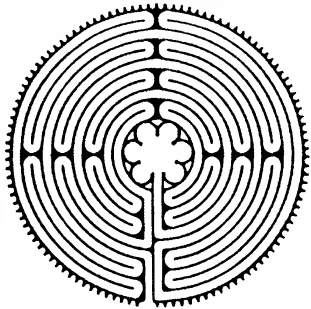
A Chartres Labyrinth, named after the one located on the floor of the
Gothic cathedral in Chartres, France. Wikimedia Commons.
There are labyrinths in nearly every city in the U.S. and usually at least one in every medium-sized town.[4] They’re often found on church grounds (typically Episcopalian or Catholic churches) but are also in botanical gardens, museums, or other cultural institutions. What I love about walking a labyrinth is that while the destination is the center of the labyrinth, walkers traverse a long winding path all within the same few square feet, never leaving one spot. It’s a walk that reminds us that the purpose of this experience is the meander– not the arrival.
Richard Rohr, a Catholic Friar in the Franciscan order and founder of The Center for Action and Contemplation[5] in Albuquerque, NM, once described the outermost portion of the labyrinth, the part where one is furthest from the center, as the “edge of the inside.” He used this metaphor to remind us that when we are in that section of our labyrinth walk, we are physically the furthest from the center destination but only seconds away from reaching it, as the labyrinth path plunges from the edge to the middle in dramatic fashion. This, he said, is much like our map through our lives: when we feel the furthest away from our center or safety, or in our darkest moments, it is typically then that we are the closest. But most importantly, we are never outside the bounds of the labyrinth. If we continue, we will reach the center. There is no other option.
I met a fox on a morning walk, once, and the encounter shifted my landscape from concrete and urban to a feral, curious desert. The space will often reshape back into its old form, but I’ll never forget that it was once something wild, something unexpected. It’s a reminder that all spaces are malleable, created only through our limited perception of the moment.
This can work in verso, however, as well.
For so many years, my anxiety would tie a melancholic or upsetting memory to a place and it would be impossible for me to untie the event to the locale. Maybe this is when my OCD began, through a series self-fulfilling prophecies.
After the trip to Yosemite with my husband, I came home deep in anxiety. The obsessive thoughts started during a panic attack in the middle of the night on our trip. I love camping—my husband and I both do—and we bought a camper van a few years ago. It was how we traveled and enjoyed our vacations during the pandemic. But camping, even in the comfort of a queen-size bed, also brought a very specific anxiety. In the middle of a national park or wilderness area, I don’t have cell service, or many modern safety nets. This stokes my anxiety, especially in the middle of the night when everything seems ominous, dark, and foreboding. Mostly, though, because in the middle of the night, my brain is not firing on all cylinders and logical thought is not my go-to. I’m stuck in lizard brain, fight or flight.
The first night of our trip, I had a crippling panic attack unlike any other I’ve had. I woke up to my heart racing and limbs shaking. The only action that calmed me down was repeating my mantra in my head for nearly 45 minutes: “This is an illusion. This is an illusion.” It was the first of many of these panic attacks, this time triggered by health anxiety and worry about being in a remote location. Next time, it would be triggered by the fear of having another. That’s the spiral of panic attacks: they become recursive, one triggered after the other. A fear of the panic attack itself. I was charting out a terrifying trail in my mind—a trail that would startle me awake, shivering and fearing for my physical and mental health. I couldn’t trust my body anymore, and I couldn’t trust my mind.
Returning
Re-turn. Turn again.
Tethered—to myself.
The only one I’ve ever belonged to.
The only one—
Who belongs
To me.
There is a thread of anxiety that weaves its way throughout the entire psychocartography of my life. A clew. If I think of my existence as a map, there are three dimensions, rather than two and the third dimension is that thread. It takes up space, colors the landscape, knots and tugs around entire decades in time and space. I can’t unravel it, but I can try to pick up that thread and spin it into something productive, sometimes wear it so thin that it’s barely visible. I can hold it between my thumb and forefinger and thread it through the smallest needle and stitch a scene so vividly bright that it ceases to be anxiety and transforms. It transitions into joy, wonder, hope; solitude and contemplation; awe. Maybe that’s what these words are, less an unraveling than a reweaving, each word a stitch in the embroidery of my life. When I step back, I imagine the scene is a map, a constellation, a mosaic, which Terry Tempest Williams so perfectly calls “a conversation with what is broken.”[6]
We break and we rediscover, if we are lucky. The only way to get through the broken pieces is to discover the beauty in reassembling; the joy of putting the pieces back together, creating a new pattern, one more beautiful and nuanced than the first. We map new lines, picking up new threads, reassigning new roles to new parts of our interior. The map of our psyche is ever evolving or never evolving. We must chart our course and look back at the map we’ve created with our will.
I’m trying to retrace the labyrinth that years of obsessive-compulsive disorder and superstition have trodden out in my mind. The trails that have left me racing around them like a Mobius strip. After my most recent bout of nocturnal panic attacks, I started taking antidepressants. I was worried they’d blunt my creativity and numb me, but that’s been far from the case. I’ve been able to take my first, wobbling steps off the well-worn grooves of OCD and plot out a new path—not without fear or rumination—one that is outweighed by hope. These psychological paths are just as visceral as the physical space I walk. They have their deep, dark woods, their clearings with birdsong and the chatter of squirrels. They have more warning signs than babbling brooks, but when I step off the path, and the alarms go off, I am learning to ignore it, to find my way off the trail and chart new territories. I’m finding a way to make residing in my own skin the only home I need.
[1] George Ure wrote an eponymous book about his definition of psychocartography, but my personal definition is not related to or based on his writings or his definition.
[2] jenniferursoart.com
[3] Mao et al., “The effectiveness of exposure and response prevention combined with pharmacotherapy for obsessive-compulsive disorder,” Frontiers in Psychiatry
[4] https://labyrinthlocator.org/
[5] cac.org
[6] Williams, Finding Beauty in a Broken World, 6
