
PAIGE RIEHL: Thank you so much for talking with me about your award-winning debut poetry collection: Oil Courses, which won the 2025 Stan and Tom Wick Poetry Prize, judged by Pádraig Ó Tuama. Will you speak about the moment you found out that Oil Courses won this award? How long had you been sending your book out into the world for publication consideration? I imagine it was a thrilling moment to get the news.
CAROLYN WILLIAMS-NOREN: Thanks for talking with me about the book! Yes, getting the news of it being chosen was a thrill¾I got a phone call that I didn’t pick up, and then an email came in with a subject line that started with “Congratulations on winning…,” and the text preview was something like, “Pádraig was very enthusiastic about your manuscript…” My mind was blown. This was in September 2025, and I’d been sending the manuscript out for 14 months. It had been a finalist at two nice small presses, but it’d also been rejected about 25 times. That may sound like a long time and a lot of rejection, but I’d expected an even longer haul, based on friends’ experiences¾and on my own experience with a past manuscript that was also a finalist for a few things over several years but was never published.
PAIGE RIEHL: Yours is not an atypical experience, for sure. I’m so glad that your powerful book was recognized and now is in the hands of readers! Will you share a bit about the book’s subject matter, which revolves around the subject of oil—the business of actual oil extraction in Alaska?
CAROLYN WILLIAMS-NOREN:  I grew up in Anchorage, where my dad worked for an oil company (and I did, too, one summer during college). As an adult, I’ve made career choices very different from my parents’, and I’ve lived in various places far from Alaska, places that feel themselves to be very far from the oil industry. And, of course, the reality of climate change has become more present and alarming every year. The poems look at what I learned as a child and teenager¾in classrooms, among other kids, from my parents, from the landscape, and in that summer job in the far north. They’re mainly more narrative than lyrical, and they’re connected to one another not only by the narrative context but also by repeating images and concerns: pathways, etymology, whales, knowledge, counting and measurement. I think of Oil Courses as a memoir in poems. There are a lot of strange scenes of long-ago, far-away 1990s Alaska, but I hope the book also feels familiar¾it’s trying to reckon with the oil entanglement we’re all caught up in.
PAIGE RIEHL: The book’s title illustrates that entanglement too. Oil Courses allows for a multitude of readings and interpretations: oil courses as a noun, as in a subject in a school class or lesson; oil courses as a verb, as in movement or the direction oil can take both under and above ground, oil courses an ordered process. Will you share a bit about your selection of the book’s title and how it functions to reveal the book’s subjects and themes?
CAROLYN WILLIAMS-NOREN: The title was one of the last elements I put in place, but the meanings of the phrase oil courses had been with me all along. As I wrote, I was often thinking about the times I was closest to oil and asking myself, “What did I learn from that? What did that do to me?” So the idea of being shaped or educated by this type of resource extraction was central all along. And the idea of oil coursing or flowing has accompanied me throughout my life¾not only the knowledge of oil flowing continually through pipelines (it is, right now!), but also the creepy feeling, based on what I was taught as a child, that oil flows through our world, even through our bodies¾we’ve made it that essential to life as we know it.
PAIGE RIEHL: I appreciate how you illustrate that flow, that theme of education in the Table of Contents, which is reminiscent of a non-linear student’s class schedule or transcript—“History III [2018],” “Art IV [1992]–Now],” and “Geography I [1983]” as the first three poems, for example. As you were writing the poems in this collection, did they have these titles initially? I’m wondering if the titling and structure spurred content, or were the titles a change made later during the organization of the book?
CAROLYN WILLIAMS-NOREN: The first poems I drafted for this project were sparked by a prompt from poet and teacher Deborah Keenan: Use a line from Elizabeth Alexander’s “Praise Song for the Day” as a title. So the first ten, twelve poems I wrote, every single one was titled “[with a pair of wooden spoons on an oil drum].”
I resisted giving them more unique titles for years! I knew I was heading toward a book-length collection of poems that worked together, and in an almost superstitious way I felt that individual titles would close a door too early, keep me from accessing what else I needed to include. For a long time, I used each poem’s first line as a title, and then I used years, or locations and years.
Even after all the poems were finished (or close) and in their final order, I still was using dates as poem titles (and the uninspiring manuscript title One Way Was or Causeway), and it felt like something was missing—another poem, I thought? Or an organizing principle? I put the manuscript away for months at a time to try to get the right angle on it, and only after some distance did the idea of course titles come to me¾and then I was surprised to find that it was pretty easy to identify a course name (or a school-related title, in the case of “Research” and “Essay” and others) for each poem.
PAIGE RIEHL: Ah, I like that idea of not wanting to close the door by titling them too early, and that waiting helped you arrive at a unique structure. I’m always interested in the opening poem in a poetry collection, how it serves as an entrance to the themes of the book, an introduction to the voice, the way it establishes—in a good book—a push and pull of the conflict. Your opening poem “History III [2018]” opens with the voice of the speaker’s father over a family dinner giving a “history” of how whales were hunted for oil before oil was taken from the land. The “history” here is also about the history of the family and the disagreements that oil has caused before and the silence it causes now. I think this poem is an excellent opening for the book because of its multilayered complexity. It’s about oil and family, conflict and community, the past and the present, the ways it’s all connected. What led you to open with this poem?
CAROLYN WILLIAMS-NOREN: Thank you for that generous reading. As I added to the manuscript I reordered the poems many times, but this poem was in first position in just about every version. As you said, the poem introduces several of the book’s themes (to the ones you listed, I’d add the theme of gender¾a sneaky one, but important and definitely present in that corset image). Besides that, I wanted the book to open near the moment when I started writing the poems. I wanted to show a current moment that was as strange as the odd Alaskan stories, and to give a sense of the people and relationships involved and where I live as I look back.
PAIGE RIEHL: You called Oil Courses a memoir in poems. Will you talk about that a bit more?
CAROLYN WILLIAMS-NOREN: Sure. As you know, in many poems there’s distance between the speaker of a poem and the writer of the poem, but in this case the speaker is me, as much as any speaker can be. I wrote these poems with curiosity about a lot of subjects, but the main authority in them is my own consciousness. Like a memoir, the collection tries to make meaning of what I’ve experienced¾and I hope I do that in a way that’s also meaningful to others.
PAIGE RIEHL: Many of the poems grapple with a sense of shame about being connected to the oil industry through your father’s employment and your own summer job. Was it difficult to bring these poems into the public realm, particularly if this is still a sensitive topic within the family? How has your family received the collection?
CAROLYN WILLIAMS-NOREN: It was important to me to have my mom and dad read the poems before making them public¾and that step was hard. In my teens and twenties, I was very harsh about my disagreement with my dad’s choices. And after some years of that we simply didn’t talk about it¾for a very long time.
So we’ve re-opened the topic slowly, and it’s still hard to discuss directly, for lots of reasons. Fortunately, we’re on the same end of the political spectrum and we’re all on board with the facts of climate change (that it’s real, human-caused, and requires urgent attention). So we have some common ground. My dad has told me he sees things differently now than he did years ago. And I’ve said that I understand why he did what he did (I think I do). I also know my folks see why these poems are important to share. They also enjoyed a lot about the book¾seeing those familiar settings through my eyes¾even though they may not remember everything the same way.
I haven’t found it particularly hard to make the poems public. I’m convinced that being frank about our complicity (how it feels, what it consists of, what it’s done to us) is an important part of change. It’s parallel to so many other areas¾race, gender, others¾where, if we’ve benefitted from an unjust system, denying our privilege just perpetuates the problem. And if we look closely at a history we aren’t proud of, we may be better able to undo it.
For a long time, I did feel ashamed of this aspect of my life. If I ever talked about it, I treated it as though it were not mine at all. Writing the poems was a way of going back and saying, how is this mine? (One of the book’s epigraphs, a line from Sarah Vap’s Winter, asks, “What of ours is our own?”)
Of course, much of this happened a very long time ago, and as a kid much of it was outside my control. I do wish I hadn’t taken that summer job in college. But I have compassion for the 18-year-old me who did it. I was a malleable young person with very little experience and without a real spine.
PAIGE RIEHL: Your poems vibrate with the strength of nature: rhubarb “thick as my wrist” (5) and how “meltwater cut tunnels / under the snow berms” (40). Amid these vivid details lurks the inherent danger of place—the mud flats that suck people down, the vast and empty tundra that seems to loom with both promise and threat. Tell me a bit about your relationship to nature and how this relationship informs your poetic process.
CAROLYN WILLIAMS-NOREN: 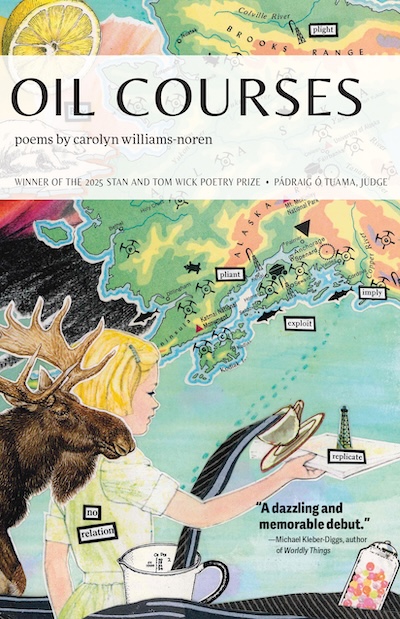 I was surprised at how much danger emerged as I wrote about those landscapes. Yes, a man gets sucked into the mud. There’s a legend about a woman who lies down in the snow and becomes a mountain. A bear kills someone¾and it’s all matter-of-fact. It’s just the nature of mud, the nature of the bear. And it’s the same with the harm humans do: just feeding our families. Just doing a science fair project (and the fishes swim sideways then float to the surface). These images emerged as I visited those memories, and they stayed in the poems because they belonged. For me, they show something about what we’re caught up in.
As an anthropology grad student long ago, I thought a lot about how the idea of “nature” has been invented by various groups at various times¾and especially how Western and Christian traditions have used the categories of “nature” and “culture” or “civilization” for their own purposes. So I’m suspicious of the category. A berm of snow pushed to the side of a road by a plow¾is that nature? How about a spider in my house? How about the electricity running through wires behind my walls? The categories get even messier as humans are now the cause of hurricanes and other disasters that used to be considered acts of god. But I do like to be outdoors, and I’m always interested in what I find there.
PAIGE RIEHL: Do you think of yourself as an environmental/eco poet?
CAROLYN WILLIAMS-NOREN: All of a sudden I’m being called one! Which is fine and also sort of funny. I don’t object, but I haven’t been aiming for that. I want to pay attention to everything around me, and that includes oak trees and the wind but also dishwashers and hairstyles and history and patriarchy.
PAIGE RIEHL: Yes! I love your attention to detail and also how cinematic your poetry feels. There’s fluidity between the daily, “normal” activities and minutiae of life—coffee cups in an office in one moment and then a zoom out to a wide angle of a tanker oil spill and back to a close-up of oil that “slick[s] every rock and pebble” (15). Are you aware of this movement in your poetry? Is it something you try to cultivate?
CAROLYN WILLIAMS-NOREN: That is always a tendency of mine¾I think I was born wanting both the whole landscape and the close-up of a pebble. And these poems lean into that inclination. It feels like a good match for the subject matter. These are global, complex problems, and we have to somehow address them with our small, daily movements.
PAIGE RIEHL: As a child, you learned about that complexity in school¾you completed science fair projects that studied oil’s viscosity, and you were told repeatedly that your very existence depended on oil (25). There’s a sense of your coming of age, and I’m wondering if that was intentional or a natural result of the subject matter and timeframe? I couldn’t help but think about the way society seems to have had a coming of age too, a slow crossing through decades to a much deeper understanding of the ways the exploitation of natural resources has long-term consequences.
CAROLYN WILLIAMS-NOREN: For sure, my coming of age coincided with growing awareness of this mess and my place in it. The crux of that is the poem “Economics IV [1989],” where I question my dad’s choices¾and the Exxon Valdez oil spill happens¾and I learn to fill the car with gas. That’s one level of awareness. I also ask, in another poem, “…how to raise / ourselves to see what’s / been done in our names” and (in another) “How / to undo what’s done us up?” Climate change calls for a further coming of age¾beyond obsessing about villains or proving our own innocence, and toward movement in the presence of contradiction.
PAIGE RIEHL: The poems in Oil Courses are peppered with the accoutrements of the industry: hard hats, gloves (always), a sniffer to detect poisonous gas, earplugs, steel-toed boots—all meant to protect the speaker and others from the associated risks of so many dangerous liquids. In “Law [1993],” you write about the saying “A teacup / is reportable,” a reference to just how little crude oil, gritty hand cleaner, paint, solvent, etc. is dangerous and must be reported if spilled. It would be easy for a less adept poet to get preachy about such subject matter, but your poems never lecture. What are the poetic methods and tools that you use to delve into complex topics without didacticism?
CAROLYN WILLIAMS-NOREN: When I was first envisioning this as a book, I was worried about how I’d get across my current opinion, something relevant for today. I fretted to Deborah Keenan a little bit, and her advice was along the lines of: You can trust that if you write the truth of what you remember while holding in mind what you know now, these poems will show what needs to be shown.
So, as a poetic method, that meant entering the dreamy state (and the child voice that so many of the poems use), and reporting those images back, and trusting that the memory, filtered through my current intention, would take the shape it needed to take. And, from there, of course, editing and tweaking for sound, for clarity, for sense and shape, all that. But, above all, trusting the images, and trusting readers to read the images.
PAIGE RIEHL: At your recent book launch in Minneapolis, you spoke about how we look for a villain to blame yet admitted, “We’re all made of oil, so dependent on it.” It’s true! We can recycle and reuse and do our best, but it’s hard to avoid the role that each of us has in our consumption thousands of products we use every day that come from petrochemical processing and refinement. Was it difficult to immerse yourself in this subject? How did approaching the subject from so many directions—art, economics, environment, geography, law, history—lead you to new insights or conclusions?
CAROLYN WILLIAMS-NOREN: I’ve been immersed in this subject for as long as I can remember! It’s second nature for me to ruminate on this and to take all the angles on it. What was new for me was setting all these stories down together, really seeing what I was taught and what I learned.
PAIGE RIEHL: Your poems are firmly rooted in a sense of place. I’m thinking of the poem “Geography VII [1992],” for example, which references the yearbook’s full-page article about kids who hit moose with their cars. These sorts of details help a reader understand what’s so unique to Alaska yet common to the people who live there. Your poems reference yearbooks, science fair projects, other memorabilia. Are you a keeper of these bits of history? Do you use memorabilia to inspire your poetry, or does it naturally spring from memory? How much broader research did you conduct to inform your poems in Oil Courses?
CAROLYN WILLIAMS-NOREN: I drafted the first dozen or so poems spontaneously, but as I expanded the collection, I often used physical objects or other kinds of “research” to reconnect with those years. I’m fickle about keeping memorabilia, so I had an odd collection to work with: a trophy, a science report, a handful of photos, and, yes, a yearbook. From there, I did some intuitive research: I found a copy of a book about oil that I read as a kid. Looked at photos and descriptions online of Endicott. Took a long detour into Ansel Adams’s life story. Creepily googled¾and, in one case, arranged a phone call with!¾people who were part of the stories that seemed important. And I dove into learning about how far-northern communities are dealing with climate change, and about whaling in the far north, and how Endicott Island was built, and other climate change–related poetry.
PAIGE RIEHL: Would you talk a bit about organizing the poems in this book? Was there a sort of narrative arc you wanted to achieve? Did you ever consider chronological organization? The ebb and flow of time and place here feels just right in the final version, but I’m interested in your organizational decision making.
CAROLYN WILLIAMS-NOREN: It was an intuitive process with a lot of parts: I wanted certain poems to be near the beginning to offer some orientation¾a kindness to readers that was important to me. Certain repeating images needed to come in a specific order. I never considered a chronological order¾I was always aiming to place what was ordinary then alongside what I know now, to show what it’s like to remember these things. The movement back and forth in time and place fits that impulse¾it lets in more complexity, I hope.
The long poem near the end, “Essay,” was the last one I finished, and to me it feels like a microcosm of the collection as a whole: Here’s how this mess of ideas works in a smaller container. I was initially worried about the repetition and thought it might not belong in the collection, and then I showed a draft of it to my friend Timothy Otte, and they drew a parallel with the album Heavy Pendulum by the metal band Cave In: It ends with a 12-minute track that reprises a lot of the themes and sounds of the earlier, shorter songs. I took that as permission to keep the long, echoey poem, make it even longer and more echoey, and use it to end the book. So if you’re looking for the most metal thing about Oil Courses, that’s probably it!
PAIGE RIEHL: Tell me a little bit about the evocative artwork on the cover of your book by Molly Keenan. The cover is so striking—the map of Alaska, the moose, the blonde girl, a cupful of oil, the oil drills—completely apropos for your book’s content. Sometimes writers don’t get to choose their cover art, but you were lucky in the freedom you had, correct?
CAROLYN WILLIAMS-NOREN: I was very lucky that Wick Poetry Center was able to fund art for the cover, and that KSU Press was open to what I wanted to do. And lucky that Molly was able and willing to make a piece especially for Oil Courses. I’ve known Molly’s work for a long time—we live in the same neighborhood¾and the textures and themes she often works with (about animals, science, classrooms) made me think the collaboration would work well. Molly read the poems, and we talked about the book’s ideas and what I hoped the cover would accomplish. Mainly, I wanted it to look approachable, interesting, and complicated. What she came up with, I couldn’t have imagined myself, and it seems exactly right¾like the ideas of the book have been dreamed through a different brain. (You can see more of Molly’s work online at facebook.com/retrofutures).
PAIGE RIEHL: At the same time you launched Oil Courses into the world, you also launched This is Good, a comic/zine of recipes, drawings, storytelling. It’s lighthearted, fun, and practical (and the recipes are good! Seriously. I recently made the split pea soup!). It feels like a counterweight to the subject matter of Oil Courses. Were you working on both at the same time? This is Good found an audience via email subscription, correct?
CAROLYN WILLIAMS-NOREN: Yes, I’ve been sending the comics out by email since the end of 2023 (regularly for a while, and now sporadically), and now I’m republishing them over the next year as a quarterly series of riso-printed zines. So I was making and sending comics during the time I was finishing and sending out Oil Courses. It was a counterweight in terms of subject matter and also in terms of process. In the midst of a long poetry project (and a lot of waiting), I enjoyed making something quickly and sharing it right away.
PAIGE RIEHL: Carolyn, again, congratulations, and thank you so much.
CAROLYN WILLIAMS-NOREN: Thank you, Paige, for these thoughtful questions!
